Hideo meets a man resembling his late father in Asakusa
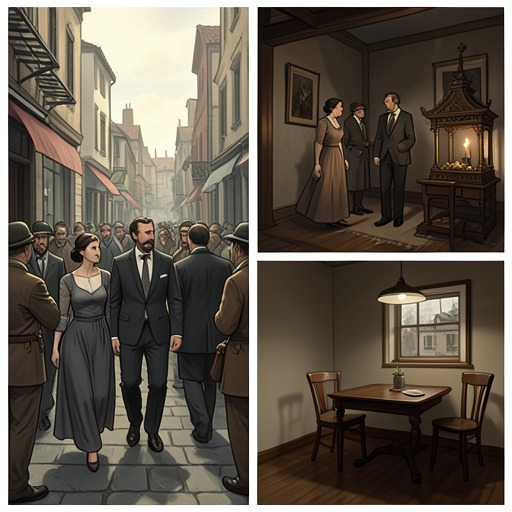
Strangers (Taichi Yamada Edition)Hideo meets a man resembling his late father in Asakusa on August 4, a day that begins in ordinary city life and turns into an encounter he cannot explain away as resemblance alone. At the Asakusa Variety Hall, the man’s voice and profile first recall Hideo’s dead father; when Hideo follows him to an apartment, a woman speaks in his mother’s voice. The event’s force lies in that progression: Hideo seeks the disappointment that would reassure him the stranger is not his father, but instead finds himself following the man toward a second, even more intimate recognition.
The day’s beginning and Hideo’s distance
The encounter is dated precisely to August 4. Late that afternoon, Hideo picks out a necktie at a department store in Ginza, telling a sales clerk that it is a gift. The clerk lays four or five ties on the counter, but Hideo finds them too dark and subdued. The specific, everyday task establishes a sharp contrast with what follows: before the evening is over, an ordinary purchase and a public performance will give way to a meeting that makes his dead parents seem present again.
That rupture comes against Hideo’s habitual caution about personal connection. After eighteen years earning his living as a scriptwriter, he has learned not to test the sincerity of polite remarks. He sees his neighbor as part of the same urban culture of empty compliments and doubts they would have anything to say to one another. A sexual relationship, he thinks, might be agreeable if it carried no troublesome emotions. His reserve helps define the stakes of the encounter: the stranger does not merely resemble someone Hideo remembers; he draws Hideo toward a family bond and an emotional exposure Hideo has tried to avoid.
Recognition in the theater
At the theater, Hideo changes seats, though at first he cannot admit to himself why. The move gives him a better angle on a man whose remark that his parents are still there has caught his attention. From his earlier seat, Hideo could see only the back of the man’s head. The voice and rear profile already remind him uncannily of his father, and he shifts position to see the man from the side.
The resemblance seems impossible on its face. Hideo’s father died when Hideo was twelve, at thirty-nine; if he were alive, he would now be seventy-five. Yet the stranger appears to be in his thirties, not the age his father would have reached. Hideo recognizes that his response is out of proportion to what he can establish, and he tries to settle himself by laughing with the audience. The performance continues around him, but he hears almost nothing. He wants to see the man’s face and discover a difference that will quiet his racing heart.
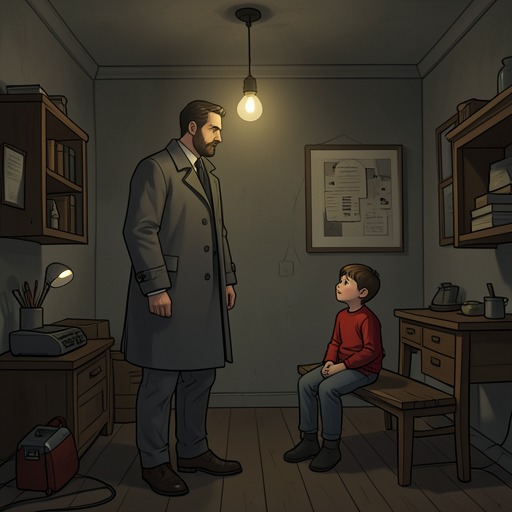
When the monologue ends, Hideo turns. The man is the spitting image of his father at the time of his death. Hideo quickly looks away, telling himself that two people can look astonishingly alike. Even after their eyes meet, he does not claim certainty based on exact memory: his recollection of his father’s features has grown vague and is supported by old photographs. He can say only that the stranger matches the father of memory and photographs so closely that, for a moment, he could swear he was looking at him. The distinction between likeness and identity remains intellectually clear, but it does not calm Hideo.
Following the stranger
Hideo worries that his staring and sudden withdrawal may have offended the man. The stranger has offered a smile, while Hideo has turned his eyes away; he imagines the man may think him strange. Then a voice speaks close by, and Hideo finds the man standing in the aisle at the end of his row. The man proposes that they leave. Hideo asks whether he means him, his voice trembling, because the living image of his father is still before him.
The man starts for the door without waiting for an answer. His departing figure suggests no doubt that Hideo will follow. As the orchestra signals the next act, Hideo rises and hurries after him. This is the event’s decisive change in action: the stranger’s resemblance had first made Hideo an involuntary observer, but now Hideo acts on the pull of that resemblance, leaving the performance to pursue the man into the city.
The stranger leads him to an apartment building and tells him the place is upstairs. He turns into an alley and climbs a metal staircase on the side of a small, two-story building, moving quickly but softly. Hideo follows suit instinctively. An open walkway runs along the second floor, where three doors stand; the man goes to the farthest one. Each step carries Hideo farther from the public theater and deeper into a private space associated, by the encounter, with the family he has lost.
The mother’s voice and the event’s significance
At the apartment doorway, the man calls for Hideo to come in, but Hideo remains frozen. A woman pokes her head out, smiles cheerfully, and invites him inside before disappearing back into the apartment. Hideo nearly swoons. He cannot make the situation fit ordinary experience, yet he knows he is awake: the scene feels too vividly real to be a dream. When the woman repeats her invitation, Hideo recognizes his mother’s voice and identifies the woman he glimpsed as his mother. His body shakes; choking back tears, he can manage only a weak sound.
The sequence therefore moves beyond a single resemblance. Hideo’s first recognition is qualified by memory: the man looks like his father as Hideo has pictured him. The woman’s voice, by contrast, identifies the second figure directly for him. The scene does not resolve how this reunion is possible; it records Hideo’s reactions as he confronts what he recognizes. Its power comes from the widening breach between everyday explanations and his immediate experience: a theatergoer becomes a father’s double, a private apartment becomes the threshold to a parental homecoming, and Hideo’s habitual distance gives way to trembling and tears.